




Michael Saylor has provided deeper insight into how Strategy determines whether to purchase additional Bitcoin or buy back its preferred shares, outlining a capital allocation strategy that extends beyond simply buying BTC on every price dip.
Writing in a November 20 post on X, the Strategy executive chairman presented highlights from a recent investor Q&A session that included CEO Phong Le and host Natalie Brunell. The conversation focused on Bitcoin per share, shareholder value, repurchasing preferred stock, and the firm’s capacity to fulfill financial obligations during extended market slumps.
The timing is notable. As institutional interest in Bitcoin exposure remains high, Strategy is highlighting that prudent management of financial liabilities can be just as crucial as building out its Bitcoin treasury.
How do we decide when to buy Bitcoin and when to buy back $STRC?
Why Strategy Sometimes Chooses STRC Over Bitcoin
During the investor dialogue, both Saylor and Le detailed the circumstances that prompt Strategy to issue equity, acquire Bitcoin, or buy back STRC, its variable-rate preferred stock.
This distinction is vital because each financial move fulfills a distinct objective.
Acquiring Bitcoin scales up Strategy’s direct exposure to the cryptocurrency. Meanwhile, buying back STRC—especially when the shares are valued below their $100 stated price—lowers outstanding preferred liabilities and enhances corporate financial flexibility.
Data from Strategy’s recent disclosures highlights this balance.
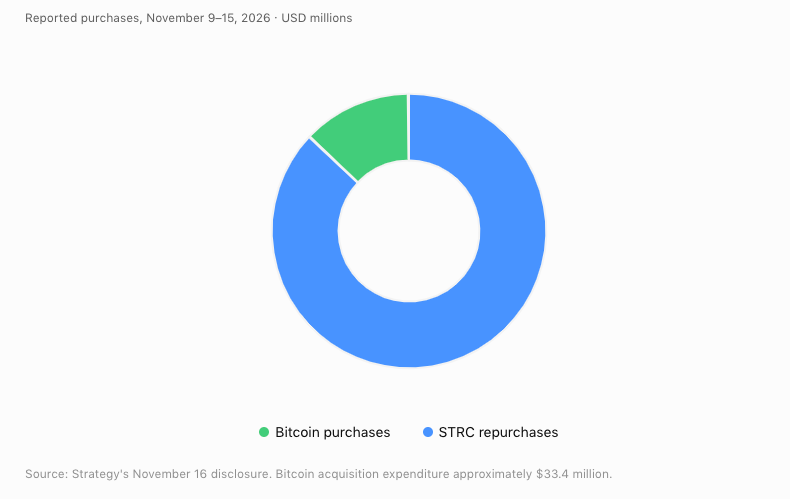
In the period spanning November 9 to November 15, the firm bought 485 BTC while devoting roughly $228.1 million to repurchasing STRC shares. By comparison, the Bitcoin purchase totaled about $33.4 million.
Consequently, Strategy directed significantly more financial resources toward preferred-stock buybacks than toward direct Bitcoin acquisitions throughout that specific reporting window.
Nevertheless, this shift does not signal a waning faith in Bitcoin. Instead, management appears focused on harmonizing long-term BTC accumulation with the underlying financial framework supporting it.
Questions regarding how corporations manage these digital asset treasuries have gained prominence as market participants scrutinize corporate Bitcoin holdings.
Michael Saylor Highlights Bitcoin Per Share
Another major theme from the November 20 event was Bitcoin per share, a metric Strategy uses to gauge how corporate financing decisions impact equity holders.
Saylor differentiated gross Bitcoin per share from net Bitcoin per share, explaining why investors operating on different timelines view these indicators through separate lenses.
Gross Bitcoin per share measures the company’s total Bitcoin exposure relative to an assumed diluted share count, whereas net Bitcoin per share factors in pertinent financial claims and liabilities.
The broader strategic question is whether Strategy can boost the economic value delivered to shareholders via capital-market maneuvers, rather than counting solely on price appreciation from Bitcoin itself.
This consideration takes center stage whenever the enterprise issues fresh equity to fund acquisitions or buybacks.
Although purchasing extra Bitcoin increases the overall stash, issuing equity also alters the denominator of ownership. Consequently, the raw quantity of BTC held by Strategy is only one of several metrics investors ought to track.
As institutional adoption of Bitcoin grows, grasping how varied financial architectures supply exposure to the asset becomes increasingly essential.
Can Strategy Keep Buying Bitcoin During A Downturn?
The resilience of Strategy’s balance sheet formed another focal point of the Q&A.
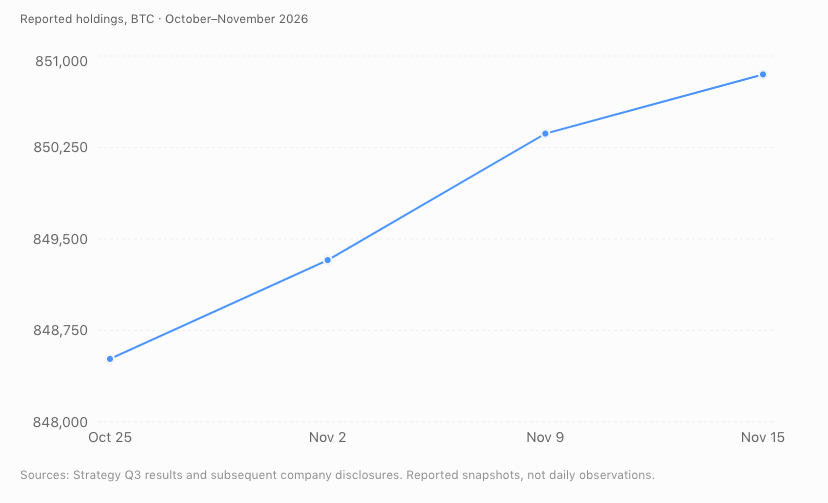
Official reporting indicates the company held 850,849 BTC as of November 15, accompanied by roughly $4.9 billion in US dollar reserves.
These dollar holdings and additional liquid assets are designed to back preferred dividends, service debt, and facilitate comprehensive treasury administration.
Additionally, the firm has pointed to roughly 3.4 years of coverage for its interest and dividend commitments at existing rates.
These monetary details are outlined thoroughly in Strategy’s third-quarter 2026 financial results, which supply additional context regarding its Bitcoin reserves and capital markets strategy.
Such liquidity provides a safety net against prolonged weakness in the Bitcoin market, even though future financing terms, dividend adjustments, and general volatility remain key variables.
For individuals tracking Bitcoin, the key takeaway is that Strategy’s accumulation strategy is maturing in complexity.
Rather than funneling every available dollar into automatic Bitcoin purchases, executives are weighing the merits of expanding BTC reserves against fortifying the financial instruments that anchor them.
Saylor’s most recent comments indicate that Bitcoin remains Strategy’s primary long-term asset, while refined capital management plays a progressively vital role in how the company builds out its exposure.

Written by

 Yuki Yamamoto