



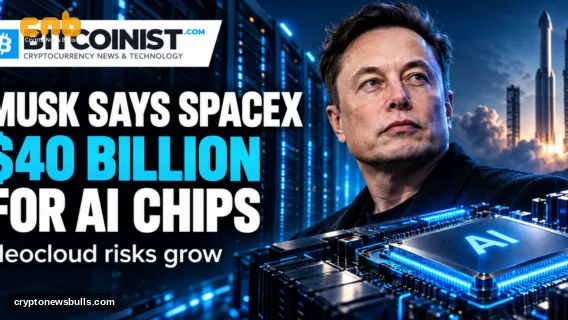
According to Elon Musk, SpaceX has locked down $40 billion in debt financing dedicated to artificial intelligence infrastructure, underscoring the massive financial demands of the AI computing race. Along with the funding news, Musk cautioned that specialized cloud providers could experience widespread consolidation as lenders grow more selective about backing businesses whose income relies heavily on AI data centers.
TL;DR
- $40 billion financing: Musk states that SpaceX secured callable debt earmarked mostly for buying GPUs.
- Neocloud shakeout warning: Musk forecasts a major wave of consolidation among niche AI cloud operators as credit conditions tighten.
- Revenue diversification matters: SpaceX’s launch operations and Starlink may help it obtain funding that is out of reach for firms dependent almost entirely on AI infrastructure.
SpaceX’s Financing Highlights AI’s Growing Capital Requirements
On October 25, 2026, Musk revealed the $40 billion funding package, explaining that SpaceX was able to draw on capital thanks to its credit profile and income generated outside of AI computing.
The debt is largely callable, meaning it can be paid off early according to specific terms. While GPU shipments are anticipated during the first half of 2027, the exact link between the financing and the delivery timeline calls for a careful separation between reported information and verified contractual agreements.
This massive funding scale demonstrates the soaring costs associated with building out compute capacity for modern AI models. Graphics processing units (GPUs) are vital for training and running these systems, yet hardware purchases represent only a fraction of the total investment. Operators must also fund power supplies, cooling systems, networking gear, and specialized facilities.
Why Musk Expects a Neocloud Shakeout
Neocloud companies focus on leasing GPU processing power to artificial intelligence developers and enterprises, allowing clients to tap into high-performance hardware without constructing their own physical setups.
At the same time, these firms frequently grapple with heavy upfront expenditures prior to bringing in enough income to offset operating costs and debt payments. Should client demand slip or data center construction hit snags, meeting financial obligations becomes significantly harder.
Musk cautioned that debt markets have effectively shut their doors to enterprises lacking major revenue streams outside of AI data centers. He forecasted that over 200 neocloud providers could undergo consolidation, reducing the market to a much smaller group of survivors.
This outlook represents Musk’s viewpoint rather than a guaranteed result. How quickly consolidation unfolds will rely heavily on shifting customer demand, the business models of individual firms, and access to capital.
Diversified Revenue Could Give SpaceX an Advantage
Unlike companies focused solely on AI, SpaceX brings in cash from rocket launches and its Starlink satellite internet service. These additional income sources may reassure lenders regarding the company’s capacity to handle debt service during shaky periods in the AI sector.
Conversely, a provider whose profits hinge strictly on GPU rentals must prove that client usage will remain high enough to justify infrastructure expenses.
This distinction takes on added importance as market participants debate whether spending tied to artificial intelligence will yield lasting profits. Readers can track related updates via Bitcoinist’s technology reporting alongside their coverage of AI and blockchain.
What Comes Next for AI Infrastructure?
This funding milestone points to a widening gap between organizations capable of supporting long-term infrastructure investments and those reliant on continuous external funding. While strong credit ratings and varied income sources offer an edge, neither ensures that costly AI outlays will produce strong returns.
For extra background, coverage from Reuters regarding SpaceX’s financing offers a separate perspective on the disclosure and the lingering uncertainties surrounding its specifics.
Key markers to monitor going forward include actual infrastructure expenditures, GPU arrival timelines, lending markets, and how well neocloud companies manage to lock in long-term clients.

Written by

 Yuki Yamamoto