
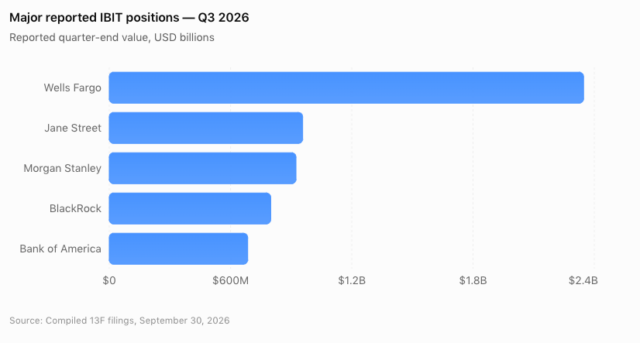
Wall Street’s ties to Bitcoin continue to deepen. Wells Fargo has revealed a substantial boost in its stake within BlackRock’s spot Bitcoin exchange-traded fund (ETF), lifting its reported valuation to roughly $2.35 billion. This milestone underscores how the cryptocurrency is finding a permanent home in conventional financial portfolios, even amidst ongoing market volatility.
The disclosure reinforces mounting proof of institutional Bitcoin adoption, with leading financial firms widening their participation via regulated investment vehicles.
As per third-quarter regulatory filings, Wells Fargo held 49,577,094 shares of the BlackRock iShares Bitcoin Trust (IBIT) on September 30, 2026.
That position was valued at approximately $2.35 billion, a notable leap from the 24,396,222 shares registered at the close of June, marking a share count increase of roughly 103%.
Wells Fargo’s Bitcoin ETF Exposure More Than Doubles
These recent figures offer a clear lens through which to view the ongoing evolution of institutional involvement with Bitcoin.
Throughout the third quarter, Wells Fargo added approximately 25.18 million shares of IBIT to its books, driving its total inventory close to the 50 million mark.
This growth stands out because the reported volume more than doubled inside a single three-month window.
However, the filing reflects positions aggregated across Wells Fargo alongside related asset-management divisions and client accounts. It does not imply that the institution spent $2.35 billion acquiring direct Bitcoin holdings for its own balance sheet.
Even so, this update underscores the rising prominence of cryptocurrency investment vehicles within mainstream financial services.
This trend parallels other indicators of institutional appetite. As previously highlighted by Bitcoinist, early demand for Morgan Stanley’s Bitcoin ETF stemmed from self-directed traders pursuing exposure via familiar financial platforms.
Taken together, these movements point to a reality where Bitcoin’s integration into traditional investment avenues extends far past a handful of niche digital asset firms.
Researcher Highlights Growing Institutional Bitcoin Holdings
Alex Thorn, Head of Firmwide Research at Galaxy, drew attention to the trend via a November 16 post on X.
Thorn noted that Wells Fargo’s reported spot Bitcoin ETF exposure expanded from about 15,917 BTC to 30,553 BTC across the third quarter.
Furthermore, he identified Wells Fargo as the largest institutional holder of Bitcoin ETFs within the data group he evaluated.
It is important to emphasize that these metrics reflect Bitcoin-equivalent exposure derived from ETF shares rather than direct custody of the underlying coins.
Thorn later clarified that nearly 85% of the recorded IBIT holdings tied back to Wells Fargo’s pair of brokerage units, demonstrating that client allocations drove the vast majority of this exposure.
This dynamic makes the growth particularly compelling from an adoption standpoint.
Rather than signaling an isolated corporate purchase, the surge points to widespread participation among everyday investors securing cryptocurrency exposure through established financial intermediaries.
What Does This Mean For Bitcoin’s Long-Term Outlook?
The most encouraging takeaway from the Wells Fargo filing lies in what it signifies regarding Bitcoin’s expanding footprint across the financial architecture.
For years, crypto investors relied almost exclusively on specialized exchanges and digital wallets to gain exposure to Bitcoin.
Today, regulated investment options enable wealth advisors, institutional managers, and conventional brokerage clients to weave Bitcoin allocations directly into their portfolios.
Wells Fargo is far from alone in this trend.
Other major financial institutions—including Bank of America and Morgan Stanley—also disclosed significant IBIT holdings at the conclusion of the third quarter.
Concurrently, BlackRock remains instrumental in bridging Bitcoin and conventional markets via its ETF lineup.
While occasional Bitcoin ETF outflows prove that institutional sentiment can ebb and flow, quarterly disclosures provide vital insight into how firmly Bitcoin has rooted itself in traditional finance.
For Bitcoin, long-term opportunity hinges on the continuous buildout of accessible investment infrastructure.
As additional banks, wealth management groups, and brokerage portals adopt Bitcoin-linked products, the asset becomes available to a wider demographic of investors.
This does not guarantee immediate price growth; the filings capture positions as of September 30 and cannot confirm whether those balances shifted during the market correction in November.
Even so, the broadening of institutional access remains a positive indicator.
Bitcoin has matured from a fledgling digital asset into a recognized investment class backed by several of the planet’s premier financial institutions.
The recent Wells Fargo disclosure offers yet another testament to that evolution.
And as Bitcoin investment products expand, we believe institutional accessibility could remain one of the most important drivers of Bitcoin’s long-term adoption.

Written by

 Yuki Yamamoto