




Fresh on-chain metrics indicate that Bitcoin investors may be experiencing a significant underlying shift, with buyers snapping up roughly 66,000 BTC across just two days of aggressive market selling. Even though the recent downturn dragged Bitcoin down toward the $62,000 mark and sparked widespread liquidations, these latest numbers point to market participants capitalizing on the discounted prices.
As previously covered by Bitcoinist, the cryptocurrency’s most recent drop heightened overall uncertainty in the market, but fresh blockchain evidence hints that this selling pressure met substantial demand close to key technical support areas.
Data from a Glassnode report shows that the recent sell-off created conditions that have historically correlated with major market turning points. Yet, the standout development may not be the losses themselves, but rather the heavy buying volume occurring right at critical support levels.
Bitcoin Accumulation Accelerates As Investors Absorb Selling Pressure
Published on November 17, Glassnode’s research titled Capitulation Meets Support spotlights a heavy concentration of Bitcoin acquisitions sitting between $62,000 and $66,000.
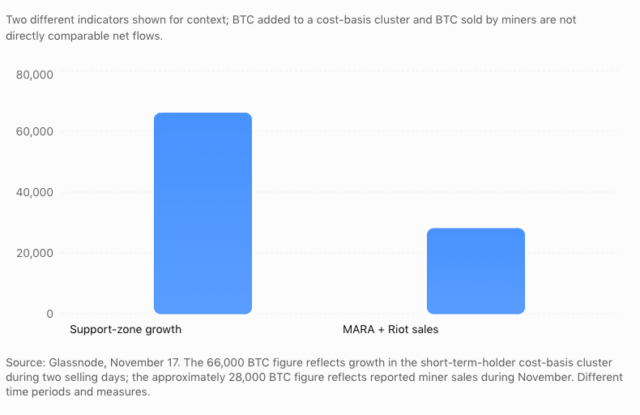
This price band accounts for about 20% of the entire supply held by short-term market participants. More significantly, the volume of BTC tied to this specific cost basis grew by about 66,000 coins over the course of the two most intense sell-off days.
These metrics imply that buyers stepped up to absorb massive selling pressure, continuing their purchases even as overall market sentiment worsened.
Additionally, Glassnode noted that realized losses climbed to levels previously witnessed near major market bottoms back in 2018, 2020, 2022, and early 2023.
The analytics platform spotlighted these trends in a November 17 post on X, drawing attention to the unique mix of capitulation, leveraged liquidations, and developing support.
These fresh findings spark a critical question: could this wave of accumulation signal the beginnings of a lasting Bitcoin recovery?
Looking back at history, sharp pullbacks paired with extreme realized losses have occasionally opened windows for more resilient buyers to sweep up coins from investors bailing out of their holdings.
However, observing accumulation within a specific price range does not automatically prove that long-term investors or whales are driving the purchases.
Why The $62,000–$66,000 Bitcoin Support Zone Matters
This latest correction has left the Bitcoin market hovering near a crucial technical juncture.
According to Glassnode’s findings, the $62,000–$66,000 corridor could play a decisive role in shaping Bitcoin’s immediate trajectory.
A sustained push above $66,000 would serve as an encouraging sign that buyers are taking back control of this immediate support zone.
Nevertheless, the more critical milestone for a recovery lies closer to $74,100, which Glassnode designates as the average purchase price for short-term Bitcoin holders.
Succeeding in reclaiming this threshold could lift sentiment by returning a much larger group of recent buyers to breakeven status.
On the flip side, a daily close underneath $62,000 risks exposing Bitcoin to further downside pressure, bringing $58,500 and $53,700 into focus as potential reference points.
Institutional Demand Could Determine Bitcoin’s Next Move
While the latest accumulation metrics offer a hopeful signal, the broader landscape of institutional demand remains a key factor to watch.
Glassnode pointed out that US spot Bitcoin ETFs registered approximately $2.6 billion in net outflows across the ten trading sessions leading up to November 13.
As Bitcoinist recently reported, BlackRock’s IBIT reversed this trend by pulling in $76.5 million on November 16, breaking a prolonged outflow streak.
This dynamic highlights an intriguing contrast between retail and institutional arenas: individuals are scooping up Bitcoin near technical floors, while wider institutional capital flows have stayed choppy.
This activity also comes on the heels of heavy redemptions from digital asset investment products. Past ETF outflows have repeatedly shown how institutional sell-offs can sway market psychology and alter short-term pricing.
Another metric worth tracking is the unwinding of leveraged positions. Glassnode discovered that November 13 and 14 brought some of the most severe long-liquidation spikes relative to open interest since 2023.
While those liquidations accelerated Bitcoin’s drop, they also flushed out a portion of the excessive leverage that tends to exacerbate market swings.
Could Bitcoin Be Preparing For A Recovery?
Even amid a rough market climate, Bitcoin’s recent on-chain indicators offer a constructive outlook.
The addition of roughly 66,000 BTC into a heavily defended support floor indicates that robust demand materialized throughout one of the market’s toughest phases.
At the same time, historical capitulation signals and the cleansing of excess leverage give observers reason to keep an eye out for potential stabilization.
Even so, a durable recovery will likely demand more than accumulation figures alone.
We believe Bitcoin’s ability to defend $62,000, recover above $66,000, and eventually challenge $74,100 will provide important clues about whether buyers can establish a stronger foundation.
For now, the latest Glassnode findings suggest that Bitcoin’s recent correction has not eliminated investor demand. Instead, the sell-off has created a closely watched contest between sellers exiting their positions and buyers willing to accumulate at lower prices.

Written by

 Yuki Yamamoto