




The World Bank Group is taking another significant step toward blockchain-based finance by announcing a new partnership with banking giant Citi and stablecoin issuer Circle to investigate how USDC could reshape international development transactions.
This development unfolds as Wall Street shows heightened interest in Ethereum, with major financial institutions increasingly looking at blockchain technology for cross-border transactions, tokenization, and settlement.
Revealed on November 17, the World Bank’s newest venture will examine whether regulated, dollar-backed stablecoins can accelerate payments, minimize transaction fees, and boost transparency during the distribution of international development funds.
Although the project is still in an exploratory phase, the participation of one of the premier global development institutions could mark a major turning point for stablecoin adoption.
World Bank Explores USDC Payments With Citi And Circle
According to the official statement from the World Bank, the organization will collaborate with Citi and Circle to study how a blockchain-powered payment framework might integrate with its current international banking operations.
Under this proposed framework, Citi would grant access to established banking channels, while Circle would supply the necessary technology to issue and settle transactions via USDC.
The goal is not to replace conventional banks, but rather to test whether stablecoins can enhance the efficiency of existing payment channels.
At present, international development disbursements frequently travel through correspondent banking channels that involve multiple financial intermediaries. Such structures can cause operational complexities, extra expenses, and delays.
Employing blockchain-based settlement could potentially streamline parts of this workflow by enabling funds to transit across participating networks with enhanced visibility.
Ajay Banga, President of the World Bank, stressed that boosting payment efficiency can yield real-world benefits for development initiatives.
Quicker transfers can ensure that vital funds arrive in communities precisely when required, bypassing the delays typical of legacy settlement mechanisms.
Significantly, the announcement does not confirm that the World Bank has started disbursing development capital using USDC. No participating blockchain, payment volume, or specific launch timeline has been shared.
Circle CEO Calls World Bank Initiative A Major Step Forward
Jeremy Allaire, CEO of Circle, welcomed the news, pointing out its capacity to broaden access to global financial architecture.
Writing in a November 17 post on X, Allaire characterized the partnership as a critical milestone for the evolution of international payments.
Allaire’s remarks align with a broader industry narrative suggesting that blockchain-based dollars will find increasing utility beyond cryptocurrency trading.
For Circle, the World Bank project could also cement USDC’s standing as traditional financial institutions review regulated stablecoins for practical applications.
Instead of remaining limited to trading environments, USDC could eventually facilitate institutional disbursements, international fund allocation, and treasury administration.
Furthermore, this joint effort builds upon the World Bank’s prior blockchain experience.
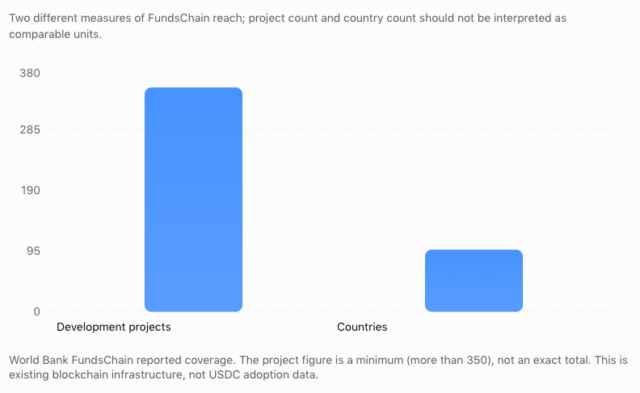
Its FundsChain network currently aids in tracking resources dedicated to over 350 development projects spanning 96 countries.
This system already enables involved entities to track project expenditures, proving that blockchain technology serves purposes far beyond crypto markets.
Could Ethereum Benefit From The World Bank’s Crypto Expansion?
The latest World Bank initiative may carry consequences for the wider blockchain sector, particularly for networks facilitating stablecoin transfers.
Ethereum remains a cornerstone of this space, hosting decentralized financial platforms, tokenized assets, and USDC transfers.
As previously reported by Bitcoinist, commercial and institutional transactions comprise a major share of Ethereum’s stablecoin transfer volume.
This indicates that blockchain-backed dollars are increasingly utilized for financial operations that reach past individual crypto transactions.
The World Bank’s research could accelerate this movement by pushing other institutions to evaluate blockchain settlement frameworks.
That said, the disclosure does not specify Ethereum as the chosen network for the envisioned payment architecture.
Because USDC operates across various blockchains, networks like Solana, Ethereum, and other compatible chains could vie for future institutional transactions.
Consequently, any potential impact on ETH will hinge on whether Ethereum is ultimately selected and if the venture fosters long-term network usage.
Even so, the move reinforces the overarching proposition that programmable blockchain systems will assume a larger role in international finance.
Traditional Banks Are Moving Closer To Blockchain Payments
This partnership also mirrors a broader evolution occurring within traditional banking.
Financial institutions are actively searching for ways to merge established payment and regulatory frameworks with blockchain-based settlement tools.
As noted recently by Bitcoinist, PNC Bank rolled out USDC payment functionality for qualifying corporate clients via Ethereum technology.
This milestone shows how banks are beginning to integrate stablecoins into offerings tailored for business and institutional clients.
Citi’s involvement in the World Bank project serves as another illustration of this mounting engagement.
Operating across more than 180 jurisdictions, Citi brings deep expertise in managing global payment channels.
Pairing that footprint with Circle’s stablecoin architecture offers a chance to study how traditional banking and blockchain settlement can operate in tandem.
Nonetheless, hurdles persist, including regulatory compliance, liquidity management, currency conversion, and the physical costs of transferring assets between traditional accounts and blockchain systems.
Such factors will help dictate whether stablecoins can provide clear benefits over legacy payment networks.
What Happens Next For USDC And Institutional Crypto Adoption?
The World Bank’s announcement marks an encouraging milestone for the gradual integration of cryptocurrencies into mainstream finance.
Instead of treating blockchain purely as a speculative asset class, prominent financial entities are exploring its capacity to solve real-world operational challenges.
Initial investigations will concentrate on payment structures involving borrower nations and intermediary financial institutions where digital asset operations are legally authorized.
Additional banking collaborators could join as the project progresses.
We believe the most critical question is whether this partnership can prove tangible gains in cost, settlement velocity, and transparency.
If successful, the model could inspire other global entities and financial institutions to test comparable infrastructure.
For now, the World Bank’s choice to study USDC alongside Circle and Citi signals further movement of stablecoins toward mainstream financial utility.
Subsequent milestones will include the identification of participating nations, specific payment mechanisms, and any official rollout timelines.

Written by

 Yuki Yamamoto