




During the first ten months of 2026, Ethereum cleared a remarkable $25.8 trillion in stablecoin transfers, underscoring the network’s growing significance in international digital finance. This milestone coincides with ongoing investigations into Ethereum-based assets by prominent financial institutions, which include JPMorgan’s tokenized money market fund.
Despite this, ETH’s market returns have failed to mirror that enthusiasm.
This gap brings up a crucial question: Is Wall Street overlooking Ethereum’s growing financial infrastructure while focusing too heavily on short-term price movements?
Ethereum’s $25.8 Trillion Milestone Reveals Growing Demand
According to the State of the Ledger report released by Ethereum Institutional on November 5, stablecoin transactions on the Ethereum mainnet totaled $25.8 trillion between January and October of 2026.
This figure marks a 61% jump from the roughly $16 trillion recorded across the same timeframe in 2025.
Additionally, the total count of stablecoin transfers surged by 2.5 times to hit approximately 463 million, indicating that network engagement broadened past simple increases in transaction volume.
It is worth noting that these metrics encompass all recorded transfers, including automated routines and internal movements. As such, they should not be viewed as representing $25.8 trillion worth of institutional settlements or retail purchases.
Even with that caveat in mind, the expansion highlights Ethereum’s critical function as the backbone for transferring digital dollars.
The data also points to a marked enhancement in operational efficiency.
Throughout the period, the Ethereum mainnet sustained a daily average of around 2.17 million transactions, representing a 54% year-over-year increase.
Simultaneously, average daily median transaction costs dropped from roughly $0.35 down to a mere $0.035.
The network is successfully processing higher volumes of activity while becoming significantly cheaper to operate.
Why Wall Street Is Paying Attention
The rise in Ethereum’s stablecoin traffic parallels an escalating interest in tokenized financial instruments.
Previously, BlackRock CEO Larry Fink drew attention to the benefits of blockchain-based financial systems, sparking conversations regarding Ethereum’s utility in tokenization.
Discussions among institutions are increasingly centered on functional architecture rather than purely speculative crypto trading.
Asset managers and banks are actively investigating how distributed ledgers can facilitate digital settlement mechanisms, asset transfers, and fund issuance.
Ethereum already features a robust framework of tokenized assets, decentralized finance apps, and stablecoins.
That mix could prove deeply appealing to institutions looking to tap into existing liquidity markets and blockchain-powered financial tools.
Even so, institutional involvement does not guarantee immediate appreciation for the price of ETH. Certain applications drive heavy network engagement without generating equivalent demand for the underlying token.
Ethereum’s Growing Network Security Adds Another Dimension
Stablecoin metrics are not the only indicators showing strong development.
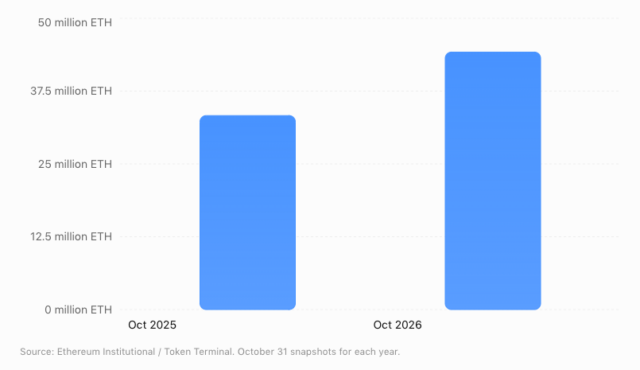
Data from Ethereum Institutional shows that the amount of staked ETH climbed from 33.3 million in October 2025 to 44.2 million by October 31, 2026.
That volume accounts for roughly 36.1% of the total circulating supply, compared to 27.6% recorded twelve months prior.
This trend introduces another layer to the broader investment outlook.
While withdrawals remain fully permitted, staked ETH reinforces network security while shrinking the pool of tokens immediately accessible for open-market trading.
Institutional participation in staking has likewise drawn notice, highlighted by Grayscale scaling up its Ethereum staking holdings earlier in the year.
Combined, the upward trajectory in staking rates and stablecoin usage indicate that Ethereum’s economic framework continues to mature in the face of market swings.
Could Ethereum’s Network Growth Support An ETH Recovery?
For investors, the core dilemma lies in figuring out how higher network utilization translates into tangible value for ETH holders.
Stablecoin transfers consume block space, yet Ethereum’s scaling upgrades have simultaneously pushed transaction costs downward.
Although lower fees make the network more accessible to users, they can also diminish the amount of ETH burned per transaction.
Consequently, higher transfer volumes do not automatically trigger a proportional surge in demand for ETH.
The most optimistic scenario relies on steady institutional participation, growing stablecoin liquidity, increased utilization of ETH as collateral, and consistent engagement in staking.
However, turning these fundamental upgrades into a sustained market rebound would still require a stronger wave of buying pressure.
Market participants should keep an eye on whether network metrics maintain their upward path, if institutional investment vehicles pull in fresh capital, and whether transaction economics scale alongside adoption.
Is Ethereum’s Biggest Opportunity Still Ahead?
Ethereum’s achievement of $25.8 trillion in transfers emphasizes a clear divide between broader blockchain adoption and asset price performance.
Compared to a year ago, the network is handling larger stablecoin volumes, supporting heavier transaction loads, and protecting more staked ETH.
Yet the broader market has not necessarily reflected those gains through higher valuations for ETH.
That discrepancy presents a compelling opening for investors prepared to judge Ethereum on factors beyond immediate price action.
If institutional adoption continues expanding, Ethereum’s long-term investment case may increasingly depend on its position as financial infrastructure rather than speculation alone.

Written by

 Yuki Yamamoto