



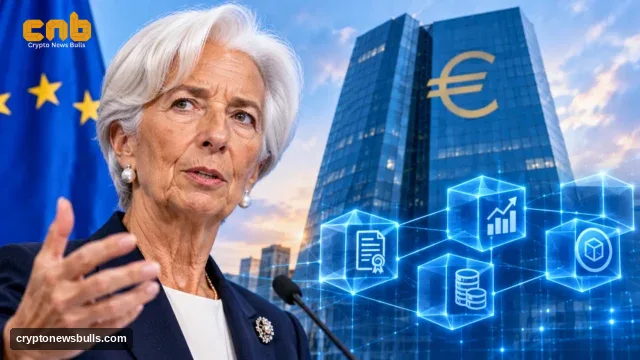
European Central Bank President Christine Lagarde has cautioned that Europe faces the danger of missing out on a unified market for tokenized financial assets unless lawmakers enact shared regulations before rival blockchain networks grow difficult to interconnect.
Addressing the Frankfurt European Banking Congress on November 20, Lagarde emphasized the expanding role of blockchain within traditional finance. Through tokenization, instruments like stocks and bonds can be issued and exchanged as digital tokens, potentially combining issuance, trading, and settlement onto a single network.
At the same time, she warned that technological advancements alone will not guarantee a cohesive European marketplace. Lacking uniform standards, financial institutions might construct isolated blockchain platforms that struggle to process cross-system transactions.
This warning arrives as the global market for tokenized conventional assets on public blockchains continues its expansion. By March, this sector reached an estimated valuation of €23 billion ($25 billion), marking a fivefold increase over the preceding year.
Lagarde Calls for Common Rules as Tokenized Markets Expand
According to Lagarde, tokenization represents a prime opportunity for Europe to forge an authentic single market for digital financial assets from the ground up. Nevertheless, she noted that the timeframe for setting common standards is tight.
As banks and financial firms increasingly embrace blockchain architectures, separate platforms risk operating under conflicting regulations. Such an outcome could hinder cross-platform settlement and result in fragmented markets rather than the cohesive financial ecosystem Europe aims to foster.
“With the right framework, tokenization offers a chance to build a genuine single market in digital assets, integrated from the start. For Europe, that is a huge opportunity,” Lagarde said.
Furthermore, she clarified that the burden does not fall solely on central banks and technology developers. European legislators must put forth the legal structures necessary to guarantee that tokenized securities can transfer seamlessly across platforms under uniform guidelines.
Her statements highlight a broader hurdle for European financial markets: constructing the underlying architecture for blockchain finance while ensuring that regulatory discrepancies do not hinder institutional adoption.
ECB’s Pontes Platform Already Supports Digital Bond Settlement
The European Central Bank has already taken proactive steps to supply the framework required for tokenized financial exchanges.
In September, the Eurosystem rolled out Pontes, a settlement network enabling banks and financial institutions to settle tokenized security transactions utilizing central bank money. This serves as an alternative to commercial bank deposits or private stablecoins for settlement purposes. The platform has already facilitated a major transaction: earlier in November, the European Stability Mechanism—the eurozone’s financial rescue fund—settled a €1 billion digitally native bond utilizing Pontes.
This transaction highlights how blockchain-based settlement is transitioning past experimental phases into larger-scale financial operations among European bodies. Additionally, the ECB has initiated preparations to allocate a portion of its foreign exchange reserves into tokenized securities, initially concentrating on euro-denominated public-sector debt.
Such moves indicate that the central bank aims to broaden the practical application of tokenization while preserving the standing of central bank money inside the financial system.
Appia Initiative Aims to Connect Europe’s Tokenized Financial Markets
Alongside Pontes, the Eurosystem is advancing its long-term Appia initiative, designed to set common standards and link Europe’s tokenized financial markets.
The project seeks to unite market participants around a cohesive framework for blockchain-powered financial services. The ECB’s broader efforts via Appia are anticipated to yield a blueprint by 2028. Even so, Lagarde underscored that shared settlement systems and infrastructure cannot solve the issue independently.
“Infrastructure alone is not enough. Common rules will be needed too, and those lie with legislators,” she said.
Her remarks draw a clear line between possessing the tech stack to settle tokenized assets and possessing the regulatory framework that permits disparate platforms to function in tandem. Without legislative alignment, Europe could wind up with advanced yet siloed markets.
Because Lagarde is slated to step down as ECB president in February 2027, this address ranks among her final policy statements at the Frankfurt European Banking Congress.
The path forward hinges on whether European policymakers can enact unified rules alongside the infrastructure currently deployed by the Eurosystem. As tokenized financial markets keep expanding, decisions made today will help shape how readily European institutions engage with this nascent sector.
Do you think Europe can establish a unified tokenized asset market before competing blockchain platforms become too fragmented? Could common regulatory standards give European financial institutions an advantage in the expanding digital securities market?

Written by
 Yuki Yamamoto