




A fresh phase of Bitcoin adoption may be underway as artificial intelligence developers investigate methods for autonomous software to execute payments without human involvement.
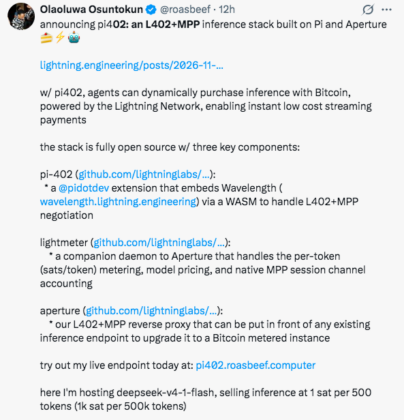
Although the Lightning Network of Bitcoin has historically concentrated on lowering transaction costs and accelerating speeds, Lightning Labs has unveiled a novel technology named pi402, granting AI coding agents the ability to purchase computing services directly with BTC.
Unveiled on November 12, this open-source innovation permits AI agents to pay for the compute power necessary to process information, generate responses, and execute various operations.
As artificial intelligence grows increasingly woven into everyday digital services, this innovation could generate an additional channel for Bitcoin payment activity.
Lightning Labs Introduces Bitcoin Payments For AI Agents
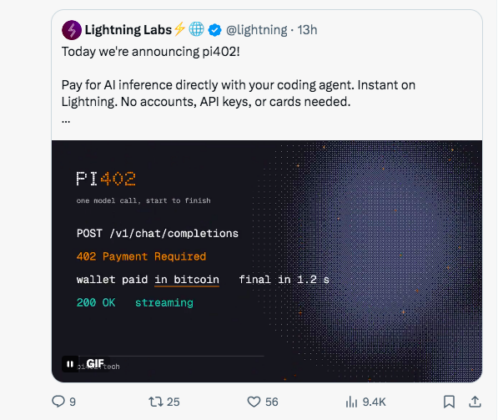
The official statement from Lightning Labs indicates that pi402 permits AI coding agents to settle inference costs directly through the Bitcoin Lightning Network.
Inference describes the computational operation that takes place when an artificial intelligence model produces an answer or finishes a task.
Historically, developers have accessed these utilities via prepaid credits, subscriptions, or accounts tied to credit cards.
Conversely, Lightning Labs maintains that this traditional payment architecture introduces unnecessary hurdles for autonomous software.
Utilizing pi402, an AI agent can request entry to a paid tool, obtain a billing invoice, settle the charge with Bitcoin, and proceed with its operations without requiring human authorization for every individual purchase.
The system leverages the L402 payment authentication protocol from Lightning, which integrates payment validation with entry credentials for digital utilities.
Upon finalization of the payment, the agent acquires the credentials required to utilize the requested computing capacity.
This sequence unfolds within seconds, potentially empowering AI applications to execute numerous micro-transactions without depending on conventional banking frameworks.
Furthermore, Lightning Labs integrated usage-based billing functionalities, allowing providers to charge for specific AI tokens instead of demanding that customers buy large upfront bundles.
This innovation expands upon previous initiatives designed to push Bitcoin payment use cases past standard cryptocurrency transfers.
Could Artificial Intelligence Create New Demand For Bitcoin?
The most compelling ramification of pi402 is the prospect that autonomous AI agents could emerge as a fresh demographic of Bitcoin users.
As artificial intelligence applications evolve in complexity, software agents may increasingly demand data, compute power, and entry to auxiliary digital platforms.
Rather than depending on a conventional bank account, these agents could leverage Bitcoin wallets to execute automated payments.
This dynamic could render the Lightning Network exceptionally appealing for micropayments.
Contrasting with traditional card networks, where fixed processing fees render micro-transactions financially unviable, Lightning accommodates transfers valued in fractional amounts of Bitcoin.
Lightning Labs noted that its system can measure AI inference down to millisatoshis, where a single millisatoshi equals one-thousandth of a satoshi.
Such precision grants developers the ability to bill for exceptionally minute quantities of computational work.
From an investment perspective, scaling payment activity could reinforce the standing of Bitcoin as an internet-native financial grid.
However, an escalation in Lightning transactions does not guarantee a direct lift in BTC market prices.
Long-term market impacts will rely heavily on broader adoption, the volume of Bitcoin stored within payment wallets, and whether demand for BTC scales in tandem with the purchased services.
Even so, the project establishes another viable use case at a juncture where institutional engagement with Bitcoin continues to widen.
Why Bitcoin Could Benefit From The Growing AI Industry
Cryptocurrency and artificial intelligence have frequently been framed as distinct technological domains.
Yet, autonomous payments possess the capacity to forge a vital bridge between them.
While AI agents display growing proficiency in executing intricate tasks, transaction processing remains a hurdle because legacy financial architectures typically demand human identities, account sign-ups, and transaction approvals.
The Lightning Network presents an alternative framework.
By empowering software to maintain capped balances and execute transactions programmatically, developers can build applications that settle service fees dynamically as consumption occurs.
Additionally, the pi402 extension features spending controls, incorporating daily budgets and per-request ceilings to help developers restrict agent expenditure.
Lightning Labs released the architecture as open source, granting developers room to test innovative payment mechanisms.
Impediments remain.
Broad deployment calls for wider acceptance of Lightning payments among AI service vendors, while developers must navigate wallet security, liquidity management, and inherent Bitcoin price volatility.
Regardless, the release marks another stride toward embedding Bitcoin into nascent digital infrastructure.
For now, pi402 functions as an emerging developer utility rather than proof of widespread commercial integration.
Should autonomous AI agents eventually mature into prominent consumers of computing utilities, however, Bitcoin could secure a pivotal function in how these algorithms exchange value.
Ultimately, that trajectory could bolster its long-term utility far beyond speculative trading markets.

Written by

 Yuki Yamamoto