



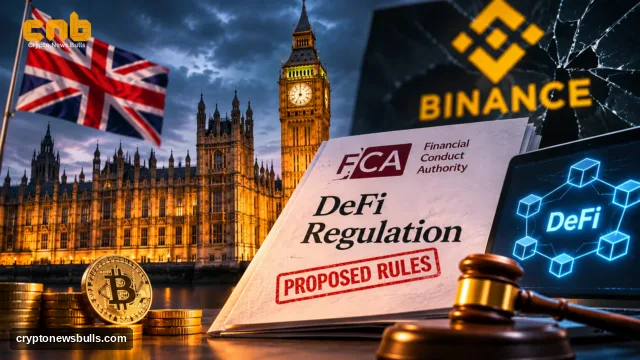
- The FCA reportedly cited the $6.3 billion Binance hack to justify stricter regulations on decentralized finance access, prompting Coinbase to argue the strategy is “creating a prohibition,” according to the Financial Times.
- Although Binance operates as a centralized exchange, stolen funds subsequently flowed through cross-chain, decentralized protocols, creating a gray area for regulators and industry participants alike.
- Coinbase’s use of the term “ban” does not reflect a formal prohibition: truly decentralized protocols remain exempt from the regulatory framework, though compliant platforms might abandon access if adherence proves overly burdensome.
- The FCA consultation (GC26/7) wrapped up on November 18, with final instructions anticipated prior to the launch of the UK crypto regime on October 25, 2027.
Fresh criticism is being leveled against the UK’s proposed decentralized finance regulations by Coinbase, following reports that the Financial Conduct Authority (FCA) pointed to the $6.3 billion Binance security breach to justify clamping down on the sector.
Britain is pursuing a harsher regulatory stance toward DeFi, with the FCA’s outlined rules sparking concerns about whether licensed crypto firms can maintain pathways to decentralized financial offerings.
This friction highlights a tricky dilemma for regulators. Even though Binance is a centralized trading platform, the fallout from its compromise threatens to impact companies providing gateways to decentralized financial tools.
For an industry centered on minimizing reliance on financial gatekeepers, that differentiation carries significant weight.
Binance’s Security Failure Reaches the DeFi Debate
The October 29 breach at Binance has already triggered parliamentary inquiries within the UK concerning consumer exposure and the cybersecurity protocols demanded of digital asset businesses.
In a written statement to Parliament on November 16, the British administration stated it was collaborating with the FCA and other regulatory bodies to evaluate how the event impacts the United Kingdom.
The anxiety extends past the initial exploit. As Bitcoinist previously detailed, digital wallets tied to the perpetrators transferred nearly $600 million worth of Ethereum via cross-chain systems.
This movement complicates the industry’s stance that centralized exchange security and decentralized finance should remain strictly partitioned. While the hack itself happened on Binance, the subsequent routing of illicit funds illustrates how closely linked the two ecosystems have become.
At the same time, leveraging decentralized networks after a theft occurred does not imply those networks caused the primary security breakdown. Defending an exchange against unauthorized entry and tracking the path of stolen capital are distinct challenges requiring specialized oversight.
Coinbase Challenges the UK’s Regulatory Approach
According to the Financial Times, Katie Harries, Coinbase’s head of European policy, characterized the UK framework as “creating a prohibition.”
Her concerns focus on whether licensed digital asset firms will retain the capacity to grant users entry to decentralized financial products under the upcoming British regulatory structure.
Published on October 21, the FCA’s DeFi consultation paper, GC26/7, explores how authorized companies ought to handle cybersecurity, operational continuity, and financial crime dangers when interfacing with decentralized mechanisms.
Consider a user navigating an on-chain lending pool via a licensed crypto exchange. While the intermediary may manage the user interaction and the front-end application used to execute orders, it does not necessarily govern the underlying lending software.
The core difficulty lies in establishing which hazards a platform can reasonably mitigate versus those dictated by autonomous software code or external governance frameworks.
Mandates drafted with traditional financial institutions in mind can prove nearly impossible to fulfill when an application relies on independently deployed smart contracts.
This is by no means an appeal to strip crypto companies of accountability. Any firm offering DeFi connectivity to its customer base must remain answerable for the utility it provides, the disclosures it makes, and its representations concerning consumer safety.
Is Britain Really Planning to Ban DeFi?
Coinbase’s assessment should not be misconstrued as an official ban on decentralized finance.
The FCA has previously noted that truly decentralized protocols sit outside its supervisory perimeter if no identifiable entity is performing regulated functions through them.
The far more complex issue centers on the enterprises bridging consumers to those networks.
The UK is grappling with a dilemma that lacks global consensus. A FATF study from July 2026 revealed that only four out of 142 reviewed regions had established licensing or registration mandates for applicable DeFi frameworks, with merely two having actually issued licenses or registrations.
Should compliance demands render these connections economically or logistically unviable, authorized platforms might choose to discontinue them. Such a shift could choke off access via well-known crypto venues without the state ever explicitly outlawing the underlying code.
There are also potential repercussions for consumer safeguards.
Cutting off avenues via licensed intermediaries will not automatically eradicate consumer appetite for decentralized finance. Certain traders might instead interact directly with protocols or turn to offshore services, where user protections could look entirely different.
That outcome is not set in stone. Direct engagement with protocols brings its own technical and financial vulnerabilities, giving watchdogs valid reasons to scrutinize how crypto firms expose users to those hazards.
The success of the proposed strategy will hinge on whether it tackles these dangers without pushing participants toward unregulated markets.
The FCA’s Next Decision Matters More Than the Consultation
The feedback window closed on November 18. The broader digital asset framework for Britain is slated to go live on October 25, 2027, with definitive DeFi guidelines expected beforehand.
The open question is whether the FCA can strike a practical balance separating the duties of supervised intermediaries from the inherent traits of decentralized software.
Coinbase has a commercial stake in safeguarding entry to decentralized financial tools, while regulators carry the mandate to shield consumers and thwart financial crime. Both viewpoints deserve critical evaluation.
Ultimately, the final guidance will decide whether licensed platforms can keep building tools tied to decentralized protocols and under what conditions.
The Binance exploit underscores the magnitude of cybersecurity threats confronting crypto markets. Whether heavier restrictions on supervised DeFi entry would have averted similar losses remains an open question that demands empirical backing.

Written by

 Yuki Yamamoto