


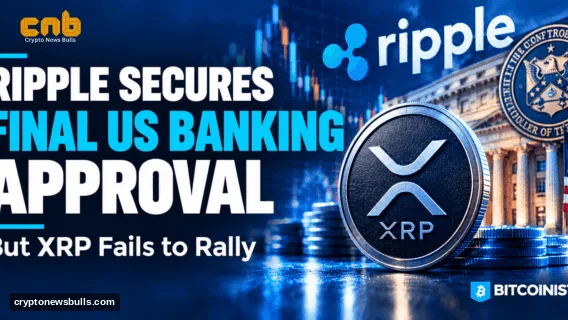
Ripple has attained final regulatory permission from US authorities to open its national trust bank, marking a key milestone in the firm’s expansion of institutional financial services. Nevertheless, this regulatory breakthrough has not sparked a significant upward price movement for XRP, underscoring the divergence between Ripple’s corporate growth and its token’s market valuation.
On October 26, 2026, the Office of the Comptroller of the Currency (OCC) issued final authorization for the Ripple National Trust Bank. This decision solidifies Ripple’s standing within the regulated financial framework, particularly as the company scales its digital asset custody and stablecoin operations.
TL;DR
- Ripple obtained final OCC clearance to launch a federally regulated national trust bank.
- The newly approved institution will handle reserves for RLUSD and deliver institutional digital asset custody solutions.
- XRP registered minimal immediate price reaction, as the authorization does not automatically drive fresh token demand.
Ripple Secures Final Approval for National Trust Bank
The OCC ruling concludes a regulatory review path that kicked off with conditional consent back in December 2025. With the final green light now in hand, Ripple can proceed to set up a national trust bank functioning under federal oversight.
Based on official statements from Ripple, the authorized operations encompass managing the segregated reserves backing Ripple USD (RLUSD), serving as collateral trustee for those funds, and offering fiduciary digital asset custody provisions.
This authorization represents a crucial stride for Ripple as it aims to cater to corporations and financial institutions seeking regulated frameworks to manage digital assets.
However, a national trust bank differs from a conventional commercial bank. Ripple’s new entity is not designed to function as a traditional deposit-taking and lending institution.
RLUSD Remains at the Center of Ripple’s Banking Strategy
This regulatory approval carries direct significance for RLUSD, Ripple’s US dollar-pegged stablecoin. The enterprise reported that the token’s market capitalization has climbed to approximately $2.5 billion, highlighting its expanding function within Ripple’s trading and institutional payment network.
Crucially, RLUSD will continue to be issued by Standard Custody & Trust Company, which is a Ripple subsidiary overseen by the New York Department of Financial Services. The newly cleared national trust bank will introduce federal supervision to the framework backing the stablecoin, including its custody-related functions and reserve assets.
This distinction is vital because the bank’s core responsibilities focus on stablecoin infrastructure and institutional services rather than direct engagement with XRP trading.
Ripple has consistently built its enterprise offerings around treasury services, payments, custody, and digital asset infrastructure. Such advancements may reinforce its wider market standing, though the ultimate financial effect will rely on product adoption and practical utilization.
Why XRP Has Not Reacted to the News
Notwithstanding the importance of this regulatory verdict, XRP failed to mount a substantial rally following the announcement. U.Today noted that the cryptocurrency changed hands between $1.30 and $1.31 in early trading on October 27, posting only slight fluctuations over the prior 24 hours.
A primary factor behind this is that the authorization strengthens Ripple’s corporate framework rather than immediately altering XRP’s supply, utility, or market demand.
Within the broader ecosystem, XRP and RLUSD fulfill distinct functions. RLUSD maintains a stable valuation tied to the US dollar, whereas XRP operates as an independent digital asset utilized across various functions within the XRP Ledger and Ripple-associated payment networks.
While enhanced regulatory standing could foster future institutional partnerships for Ripple, it provides no assurance that every corporate milestone will instantly generate buying momentum for XRP.
This nuance has also surfaced in broader conversations surrounding Ripple’s banking alliances. Bitcoinist previously explored the gap between Ripple’s corporate relationships and actual token usage in its piece, Ripple’s Bank Partner Count Does Not Mean 300 Banks Are Using XRP.
What Comes Next for Ripple and XRP?
Ripple’s final banking clearance coincides with preparations for its Swell 2026 conference in New York, slated for October 27–29. The gathering convenes representatives from the cryptocurrency industry, traditional finance, and the XRP ecosystem.
Market observers will likely monitor developments regarding the trust bank’s operational launch, institutional custody rollouts, and the ongoing adoption curve for RLUSD.
For XRP holders, the central question is whether Ripple’s expanding regulated foundation will eventually generate increased activity that directly incorporates the token. While that scenario remains possible, it is not guaranteed.
As Bitcoinist has noted in prior reporting concerning Ripple’s financial sector ambitions, securing regulatory access can bolster an enterprise’s market position without triggering a matching price surge for its associated cryptocurrencies.
At present, Ripple has achieved a major regulatory milestone, while XRP’s muted reaction indicates that investors may be holding out for clearer signs of how this evolution converts into tangible token demand.

Written by

 Yuki Yamamoto