






Avalanche is getting ready for a new stage of development that might alter how network adoption connects to the value of its native cryptocurrency, AVAX. Following a milestone where Avalanche’s tokenized asset value surpassed $3 billion in August, the focus is shifting toward capturing greater economic value from the growing ecosystem.
On November 23, Ava Labs unveiled a strategic plan centered on institutional finance, productive assets, and business payments.
Yet, the update that holds the most interest for investors is the organization’s intention to review Avalanche tokenomics, aiming to build a tighter link between network usage and the utility of AVAX.
Ava Labs Signals Changes To Avalanche Tokenomics
John Nahas, chief business officer at Ava Labs, disclosed that the firm is collaborating with the Avalanche Foundation to design economic systems that better tie AVAX to network expansion.
“New monetization models are on the horizon,” Nahas stated in an X post.
Everything we’ve built at Ava Labs has been brought under one umbrella to focus on growing the Avalanche ecosystem and driving value back to the network.
New monetization models are on the horizon, and we’re working closely with the Avalanche Foundation on tokenomics and mechanisms that better align AVAX with growing adoption.
A lot more to come
— John Nahas (@JohnNahas84) November 23, 2026
This statement tackles a central dilemma for many blockchain networks: does increased adoption of the network necessarily lead to higher demand for its underlying asset?
As outlined in the official economic research agenda from the Avalanche Foundation, researchers are currently studying protocol revenue generation, validator economics, and long-term staking rewards.
While definitive adjustments have not yet been released, these research areas signal that Avalanche is looking beyond standard transaction metrics to measure the economic advantages of blockchain growth.
Institutional Adoption Is Moving Beyond Tokenization
The institutional strategy for Avalanche places a heavy emphasis on making tokenized assets practically useful across financial markets.
The New York Stock Exchange has chosen Avalanche’s technology for its upcoming tokenized securities framework, while various financial institutions investigate blockchain-driven lending, settlement, and collateral solutions.
As previously covered, firms building regulated tokenized securities are increasingly looking toward public blockchain networks like Avalanche.
Even so, the mere issuance of assets on a blockchain is just the initial phase of adoption.
The true long-term opportunity hinges on whether those digital assets create ongoing economic activity through trading, settlement, lending, and other financial services.
If Avalanche can implement systems that harness value from these financial operations, AVAX could take on a more prominent function within the network.
Avalanche’s Expanding Financial Ecosystem
Recent data also offers a clearer picture of how Avalanche fits into the tokenized financial asset landscape.
Figures published on November 22 valued Avalanche’s tracked real-world asset market at roughly $850 million, with Centrifuge and Securitize driving a significant share of that total.
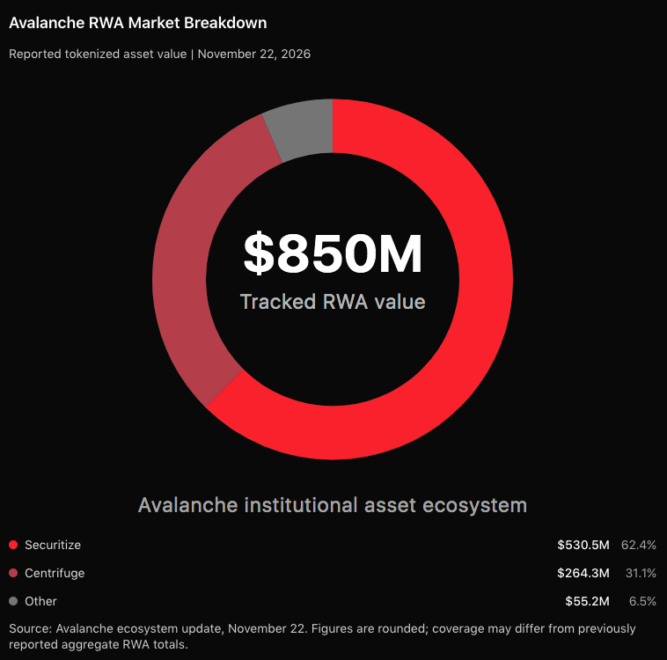
The clustering of assets on these established tokenization platforms highlights the significance of institutional infrastructure inside the Avalanche environment.
However, these statistics should not be mistaken for direct investments in AVAX.
This exact distinction explains why the proposed economic updates could prove vital for token holders.
Could AVAX Develop Stronger Supply And Demand Dynamics?
The economic model of Avalanche already features network transaction fee burning and staking mechanisms.
Earlier in the year, staking activity on Avalanche hit approximately $204 million in value, with staked coins making up about 43% of the circulating supply at that time.
Broadening the utility of AVAX via supplementary economic structures could potentially reinforce the tie between institutional operations and token demand.
Still, the success of any upcoming model will rely heavily on its engineering, rollout, and ability to remain competitive.
Imposing excessive costs on businesses might deter adoption, whereas weak value capture could restrict the advantages for holders of AVAX.
What Comes Next For Avalanche?
We believe the updated strategic direction from Avalanche tackles one of the crypto sector’s biggest economic hurdles: turning technological adoption into enduring token utility.
As institutional involvement grows, market participants will likely monitor protocol earnings, staking rewards, and the correlation between commercial activity and demand for AVAX much more closely.
At this time, no precise tokenomics modifications or launch timelines have been confirmed.
Nevertheless, the partnership between Ava Labs and the Avalanche Foundation indicates that the economic role of AVAX is turning into a top strategic focus.
Should Avalanche successfully connect growing institutional adoption with sustainable token utility, the network could establish a stronger foundation for its next phase of development.

Written by

 Yuki Yamamoto

 crytonewsbulls