






Key takeaways
- Addresses holding 1,000 to 10,000 BTC added 121,117 BTC (4.29%) between September 30 and November 21, even as Bitcoin fell 29.5%.
- That breaks a pattern seen in seven of the previous nine fourth quarters, and reverses a drop of nearly 203,000 BTC in Q4 2025.
- Whale profits have collapsed: unrealized profits fell from $124.7 billion to $23.8 billion, and the profit margin dropped from 33.9% to 5.7%.
- Whale-sized exchange inflows rose to 5,012 BTC per day in November, while US spot Bitcoin ETFs saw $453 million in net outflows on Wednesday.
- A durable recovery likely needs ETF inflows to return and Bitcoin to hold above $60,000.
Will Bitcoin bounce back before the close of 2026? Fresh data published Friday provides a glimmer of hope for market participants, showing that wallet addresses containing between 1,000 and 10,000 BTC grew their collective holdings by 121,117 BTC despite a 29.5% price correction across the tracked timeframe this quarter.
This accumulation deviates from historical trends recorded in seven out of the past nine fourth quarters, during which large-scale investors typically trimmed their positions.
Additional indications of renewed demand surfaced within the derivatives sector earlier in the week, where prominent holders executed $366 million worth of buy orders.
Nonetheless, a different narrative accompanies these metrics. Large investor profits have experienced steep declines, exchange deposits are climbing, and the leading cryptocurrency continues to face obstacles in securing a solid rebound past the $60,000 threshold.
Bitcoin Whales Are Breaking a Historical Pattern
A November 27 report issued by CryptoQuant, with backing from the digital asset lender CoinRabbit, indicates that wallets maintaining 1,000 to 10,000 BTC expanded their total reserves by 4.29% from September 30 through November 21.
Consequently, this demographic now commands roughly 2.95 million BTC.
This shift stands out sharply when contrasted with the corresponding timeframe last year. In Q4 2025, holdings across this specific tier dropped by nearly 203,000 BTC.
Current behavior runs entirely counter to that trend, even amid a marked worsening of overall market health.
While rising balances among major holders can signal that wealthy traders perceive underlying value at prevailing valuations, wallet fluctuations do not automatically confirm direct open-market acquisitions. Internal wallet transfers and custody adjustments can equally affect these statistics.
Crucially, ongoing softness in Bitcoin’s price action implies that any genuine accumulation has not yet canceled out selling pressures present elsewhere in the ecosystem.
Even Bitcoin Whales Are Starting to Feel the Pain
Perhaps the most telling metric in the analysis is not the volume of Bitcoin secured by whales, but rather the extent to which their profits have evaporated.
Unrealized gains for this cohort plunged from $124.7 billion down to $23.8 billion throughout the study window. By November 21, their unrealized profit margin rested at a mere 5.7%, a steep decline from 33.9% at September’s close.
Furthermore, CryptoQuant calculations showed that the group’s realized profit and loss swung to an average daily loss of $41 million throughout the quarter.
Such metrics challenge the assumption that large players are simply scooping up discounted coins in expectation of an immediate rebound.
Aunque high-net-worth investors generally possess greater financial staying power than retail traders, they remain vulnerable to economic strain. Should Bitcoin’s downturn persist, certain participants may find themselves forced to liquidate within the very market they were previously accumulating.
This scenario gains plausibility given that large-scale exchange inflows climbed to a daily average of 5,012 BTC during November. Although inbound exchange transfers do not guarantee immediate sales, they complicate any straightforward interpretation of accumulation trends.
Financial headwinds stretch well beyond the asset’s top-tier holders. Glassnode statistics indicate that realized losses measured against capital inflows over the prior year have hit their most severe phase since the 2022 FTX collapse. Similar capitulation events have historically materialized around past cycle troughs, though such indicators alone cannot definitively verify a market bottom.
What Needs to Happen for Bitcoin to Recover?
Sustained institutional capital demand continues to represent a primary hurdle.
As NewsBTC previously highlighted, ongoing capital flight from US spot Bitcoin exchange-traded funds has weakened the foundation for a lasting recovery.
Figures supplied by Farside Investors peg Wednesday net redemptions at $453 million, led by BlackRock’s IBIT with $329.7 million in outflows. Friday figures awaited formal confirmation at the time of publication.
Wider context from CoinGlass illustrates how ETF flow dynamics have shifted during the correction. Recent trading sessions are heavily skewed toward withdrawals, contrasting sharply with the massive influxes seen during prior bullish phases.
A reversal back toward consistent ETF inflows would offer tangible proof that buying interest is expanding beyond the whale addresses highlighted by CryptoQuant.
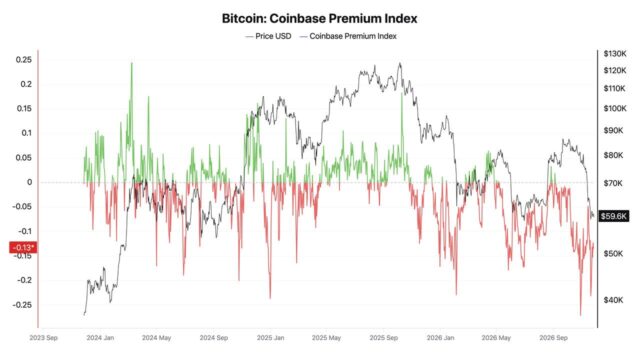
Another metric requiring close observation is the Coinbase Premium Index, which tracks price disparities for Bitcoin between Coinbase and Binance.
The most recent reading hovers near negative 0.13%, implying that buying pressure on Coinbase stays subdued compared to Binance. A lasting return to positive values, paired with renewed ETF inflows, would reinforce the outlook for reviving US-based market demand.
Technically speaking, Bitcoin’s daily timeframe yields minimal assurance that a durable reversal has begun. BTC continues printing lower highs and lower lows, with the latest leg down breaking beneath the $60,000 mark.
Immediate hurdles involve recapturing the $63,000 to $64,000 band, followed by a heavier resistance zone stretching from $68,000 to $71,000. Reclaiming these barriers successfully would bolster the case for a recovery.
Conversely, support near the recent low around $55,000 remains critical. A breakdown below this floor could invite extended losses and invalidate hopes for a year-end bounce.
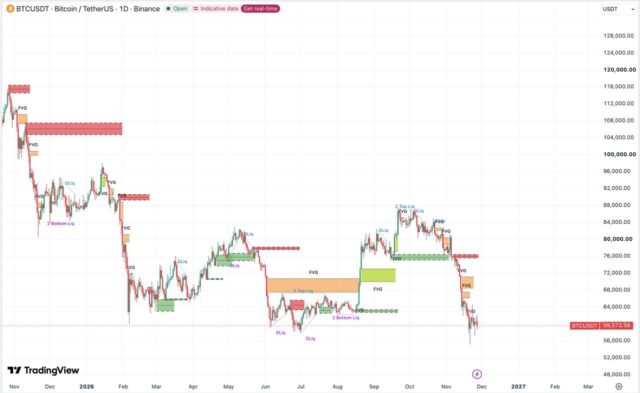
Presently, the groundwork for a recovery is starting to take shape across isolated sectors of the market, but concrete proof that aggregate buying pressure can overcome the wider downtrend remains scarce.
Could Bitcoin Recover Before 2027?
An upward reversal prior to year-end stays within the realm of possibility, specifically if selling momentum subsides and institutional capital flows turn positive.
However, bouncing back from recent lows and reclaiming previous all-time peaks represent two entirely distinct challenges.
The newest whale metrics lend stronger backing to the former scenario rather than the latter. They indicate that certain large investors are rebuilding exposure during a phase of heavy market friction, though they do not verify that a definitive cycle bottom has been established.
Investors seeking confirmation should focus less on sporadic price rallies and more on whether genuine demand is broadening across multiple market segments.
Bitcoin may be growing more affordable for long-term participants, but discounted prices and readiness for a sustained recovery are not necessarily synonymous.


 Yuki Yamamoto

 crytonewsbulls