




Key takeaways
- The House Financial Services Committee formally reported the amended American Reserve Modernization Act (H.R. 8957) on November 24; it now awaits possible consideration by the full House.
- The bill would bar the government from selling, exchanging, auctioning or pledging reserve Bitcoin for at least 20 years after enactment, going further than the March 2025 executive order.
- The amended text counts the 20 years from enactment rather than each deposit, and replaces quarterly proof-of-reserves reports with annual public reporting.
- It does not set a purchase schedule or target and rules out new taxes, borrowing or deficit spending to buy Bitcoin.
- The commitment remains a proposal: a House floor vote has not been scheduled.
Federal law is one step closer to shielding the US Strategic Bitcoin Reserve after the House Financial Services Committee formally reported an amended bill on November 24 that aims to block the sale of reserve-held Bitcoin for a minimum of 20 years.
H.R. 8957, also known as the American Reserve Modernization Act of 2026, has landed on the House Union Calendar, positioning it for potential review by the entire chamber.
Republican Representative Nick Begich of Alaska and Democratic Representative Jared Golden of Maine originally introduced the legislation in May.
Although these proposed restrictions could alleviate anxiety regarding future government Bitcoin liquidations, the revised text provides fewer provisions for fresh acquisitions and financial transparency than some cryptocurrency advocates might anticipate.
US Government Could Be Locked Into Holding Bitcoin for Two Decades
Section 5 of the updated bill mandates that Bitcoin placed in the reserve must stay put for at least 20 years following the enactment of the law.
The limitations go beyond mere sales. During this timeframe, the government is also barred from exchanging, auctioning, or using the reserve’s Bitcoin as collateral.
This measure exceeds the scope of President Donald Trump’s March 2025 executive order, which previously established a policy against selling reserve Bitcoin.
The difference is legal rather than financial; whereas an executive order can be undone by a subsequent administration, altering statutory retention rules typically demands further legislative action.
Even after the 20-year window closes, the Treasury would not automatically have the green light to liquidate the entirety of the reserve, as the bill permits recommendations to unload up to 10% of reserve assets across any two-year stretch.
Furthermore, the Treasury must review circumstances—such as national security and financial stability issues—that might warrant earlier sales, with any potential legislative exceptions requiring review by Congress.
Congress Has Quietly Changed Two Important Provisions
A review comparing the original May legislation with the revised November draft shows lawmakers have adjusted certain safeguards for the reserve.
While the initial bill mandated that each newly deposited batch of Bitcoin be held for 20 years from its specific deposit date, the updated version drops that requirement in favor of calculating the minimum holding window directly from the date the bill becomes law.
Reporting obligations have also shifted.
The previous iteration asked for quarterly proof-of-reserves audits, whereas the amended text mandates annual public disclosures backed by an independent auditor skilled in cryptographic verification and overseen by the US Comptroller General.
Independent checks on government stockpiles serve as a vital accountability tool for Bitcoin supporters. However, cutting public reporting frequency from four times a year down to annually leaves extended stretches where taxpayers have less insight into asset management.
A government reserve holding Bitcoin across decades should not be mixed up with one that requires minimal oversight.
Will the United States Actually Buy More Bitcoin?
For investors, the critical distinction is that safeguarding current government stashes does not automatically translate into fresh buying pressure.
Section 9 directs the Commerce and Treasury departments to explore whether extra Bitcoin can be acquired without adding to national debt or burdening taxpayers.
Potential strategies include converting other government-held digital assets into Bitcoin.
Even so, this section sets no mandatory acquisition timeline or minimum purchase targets.
In fact, the language explicitly forbids sanctioning new taxes, borrowing, or deficit spending to fund Bitcoin purchases.
Consequently, immediate market effects are more restrained than headlines might imply. Staving off future government liquidations eliminates an overhang of potential selling pressure, but it guarantees no massive influx of new demand.
Locking up public assets indefinitely also carries economic trade-offs, since Bitcoin prices fluctuate and holding prevents the state from deploying capital elsewhere. Whether this strategy ultimately helps taxpayers rests on the cryptocurrency’s long-term trajectory and broader fiscal conditions.
The Bitcoin Reserve Still Faces a Congressional Hurdle
The House Financial Services Committee voted 28 to 21 to pass the amended measure in September.
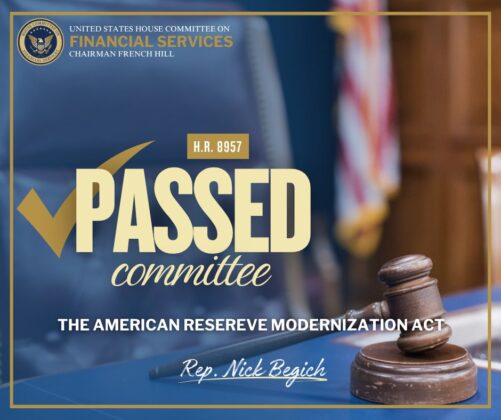
While reporting the bill this week brings it closer to a floor vote, it does not guarantee one will take place.
When the legislation launched in May, Rep. Golden maintained that establishing a reserve backed “by the weight of law” would bring greater stability to federal crypto guidelines, according to press notes from Rep. Begich’s office.
Realizing that goal depends entirely on whether Congress passes the bill before the current legislative term concludes.
For holders of Bitcoin, the next significant milestone is not another political statement of support, but whether the House sets a voting date and the bill clears subsequent legislative steps.
Until that happens, Washington’s proposed 20-year commitment to Bitcoin remains an aspiration rather than a binding legal mandate.

Written by

 Yuki Yamamoto