




Key takeaways
- BNB Chain has proposed a new Layer 1 blockchain that allows users to interact with public DeFi applications using funds held in a shielded pool.
- Private payments conceal the parties, asset and amount, while certain public contract interactions remain visible.
- The proposed AtomicCall mechanism allows users to execute supported DeFi transactions without publicly revealing who owns the resulting assets.
- The design includes selected BEP-20 tokens, but the available technical documentation identifies native BNB as the currently supported deposit asset.
Observers watching a decentralized exchange on the proposed new BNB Chain network can see which contract handles a specific swap, along with the exact inflow and outflow amounts. However, identifying who ultimately owns the resulting proceeds remains elusive.
This exact distinction forms the core of a November 26 litepaper release from BNB Chain detailing a brand-new Layer 1 network built to merge private transactions with public decentralized finance.
Functioning alongside BNB Smart Chain, the prospective blockchain utilizes native BNB and lets participants route funds through a shielded pool prior to engaging with compatible applications.
Crucially, BNB Chain is not forcing decentralized exchanges to adopt privacy frameworks; instead, it is transforming how users connect with them.
What A Block Explorer Would Actually Show
Consider a scenario where an enterprise deposits 10 BNB into the network’s shielded pool. Any block explorer will readily display the originating funding address alongside the exact size of the deposit.
If that same enterprise subsequently transfers a portion of those funds internally to a supplier within the pool, the network validates the payment securely. It achieves this without exposing the sender, recipient, asset type, or transferred value publicly, though transaction fees may remain visible depending on how the transfer is submitted.
The system’s underlying mechanics are detailed in technical explanations concerning BNB Chain’s native privacy infrastructure.
Rather than tracking traditional public balances for shielded capital, the architecture employs encrypted artifacts called notes. By leveraging zero-knowledge proofs, the network confirms transaction validity without revealing underlying financial data.
This represents an alternative accounting model for blockchain transactions, moving beyond simple wallet address obfuscation.
Bitcoinist has previously reported on how blockchain analysts traced stolen Bitget assets into a Zcash shielded pool. While initial public deposits gave investigators a starting point, following the trail deeper introduced substantial complexities.
The framework proposed by BNB Chain introduces yet another layer of complexity to this dynamic by integrating seamlessly with public financial applications.
Private Ownership Meets Public Trading
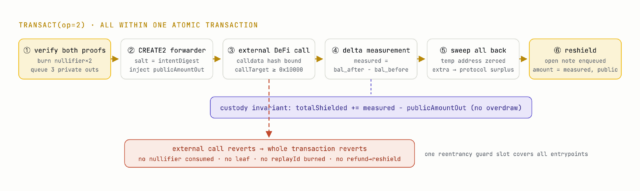
When the enterprise uses 2 BNB from its shielded reserve to execute a compatible token swap, the protocol initiates what is designated as an AtomicCall.
During this process, capital briefly exits the private ledger environment to engage with a public smart contract, subsequently returning directly to the shielded pool inside a single atomic transaction.
External parties inspecting the public interaction can view transaction volumes, the specific exchange contract, and instructions sent to it. Resulting assets re-enter the pool via an open note structure, logging asset types and quantities while shielding the owner’s identity.
For commercial entities looking to protect corporate treasury movements from corporate espionage, this mechanism offers distinct advantages over standard public wallets.
Even so, private ownership should not be mistaken for absolute anonymity.
If a relatively low-volume shielded pool experiences an isolated deposit immediately followed by a matching public swap, clever observers can correlate timing and volume. Such vulnerabilities diminish naturally as network adoption and transaction density increase.
In short, the efficacy of the privacy design heavily relies on user scale.
That particular challenge extends far beyond the reach of pure cryptography.
Which Assets Can Actually Use It?
Perhaps the most critical questions surrounding BNB Chain’s initiative pertain to supported assets rather than cryptographic math.
Although broad plans encompass BNB alongside select BEP-20 tokens—opening pathways for stablecoins—current developer documentation restricts implementation deposits strictly to native BNB.
This distinction holds substantial weight.
Businesses managing payroll, vendor payments, or invoices are unlikely to welcome market volatility risk simply to preserve financial confidentiality. Stablecoin integration is vital to making these commercial applications viable.
Additionally, the project must prove cryptographic security through third-party audits evaluating the circuits tasked with verifying private operations.
The standout promise of BNB Chain’s proposal lies in integrating privacy directly into established financial tools instead of forcing users to abandon public DeFi altogether.
Whether this strategy succeeds commercially rests on asset compatibility, supported apps, system security, and broader user migration into the shielded pools.
Unveiling the litepaper marks a step forward, but it is not yet proof that these hurdles have been cleared.

Written by

 Yuki Yamamoto