Bitcoin faces an impending political test in the wake of the 2026 US midterm elections, with Democrats poised to assume control of Congress and reportedly weighing fresh cryptocurrency legislation. This shift introduces a new dynamic to ongoing regulatory debates and highlights what Washington’s evolving political climate could portend for the world’s premier cryptocurrency.
The November 3 elections resulted in projected Democratic majorities across both the House of Representatives and the Senate, altering the political backdrop for President Donald Trump’s digital asset agenda.
House Democrats are now reportedly evaluating a measure that would grant the Securities and Exchange Commission (SEC) expanded supervisory powers over digital assets while adding heightened investor protections.
Though the initiative remains in its infancy, these conversations signal that cryptocurrency regulation is primed to emerge as a major flashpoint when the incoming Congress convenes in January 2027.
Democrats Prepare New Crypto Legislation After Midterms
Reporting from journalist Eleanor Terrett indicates that House Democrats are exploring plans to expand Representative Maxine Waters’ Crypto Investor and Consumer Bill of Rights into a comprehensive digital asset market structure framework.
This prospective legislation may incorporate concepts previously weighed during negotiations over the Digital Asset Market Clarity Act, widely known as the CLARITY Act.
One contemplated adjustment involves granting the SEC a broader oversight mandate while trimming certain responsibilities from the Commodity Futures Trading Commission (CFTC).
Terrett disclosed this progression on X, attributing the information to industry sources close to the talks.
These discussions follow the September failure of the CLARITY Act to pass the Senate, despite receiving backing from President Trump and various crypto industry associations.
Democratic lawmakers have consistently argued that digital-asset rules require robust consumer safeguards, financial protections, and limitations on potential conflicts of interest among government officials.
Conversely, Republican champions of the prior bill have stressed the necessity of regulatory clarity and definitive guidelines for cryptocurrency enterprises.
Such fundamental disagreements are likely to take center stage in upcoming negotiations.
This political pivot also arrives on the heels of heavy digital asset campaign spending, during which industry-aligned groups funneled millions into congressional contests.
Nevertheless, the electoral outcome does not signal an outright halt to the progression of cryptocurrency legislation.
Could Bipartisan Support Benefit Bitcoin?
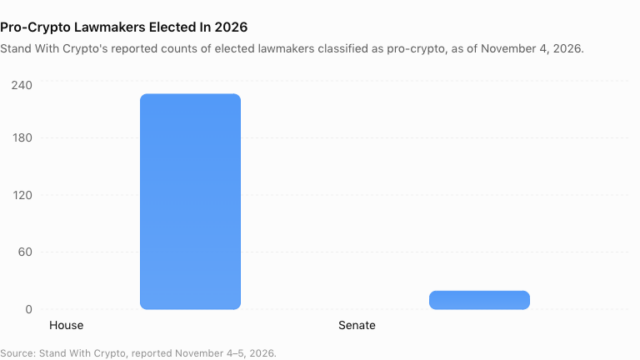
Despite the shift in the balance of power within Washington, crypto advocacy groups have pointed to a significant cohort of newly elected legislators who favor digital assets.
The industry advocacy coalition Stand With Crypto announced that upwards of 50 new pro-crypto officials are bound for Congress following the November vote.
The group published these metrics on X, reiterating its commitment to collaborating with lawmakers from both sides of the aisle.
The organization congratulated victors and noted that its advocates intend to maintain active engagement with the incoming legislative body.
This bipartisan involvement could prove vital as officials negotiate forthcoming digital asset laws.
For Bitcoin, shifts in regulatory policy can directly impact institutional confidence, market accessibility, and investor sentiment.
Still, the correlation between political decisions and Bitcoin price action is rarely straightforward.
As evidenced by recent market turbulence, broader macroeconomic conditions, market liquidity, and institutional investment flows often drive price shifts alongside regulatory developments.
President Trump’s Strategic Bitcoin Reserve initiative additionally remains central to broader policy conversations.
The administration instituted the reserve via an executive order in March 2025, though separate statutory measures would be required to establish a permanent legislative framework.
While the incoming Congress could shape the destiny of such proposals, the election outcome does not automatically invalidate existing executive directives.
In the interim, the SEC and CFTC retain the ability to pursue specific regulatory initiatives under current statutory authority.
For Bitcoin investors, the central question is whether the incoming Congress can successfully formulate clearer guidelines while addressing demands for enhanced consumer protection and financial oversight.
The political transition is already underway. According to the Associated Press, lawmakers returned to Washington this week for the remaining lame-duck session ahead of the January turnover.
The months ahead will prove critical in determining how policymakers approach Bitcoin and the wider cryptocurrency sector.
While political uncertainty may trigger short-term market volatility, Bitcoin’s decentralized network continues to function independently of any policy shifts in Washington.
The next pivotal milestone will be determining whether legislators can reconcile competing regulatory blueprints into a coherent bill capable of securing bipartisan approval.

Written by

 Yuki Yamamoto