



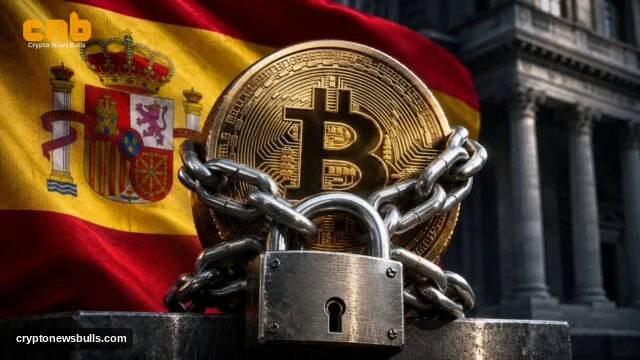
Spain is stepping up its oversight of digital assets through a new policy enabling the nation’s financial intelligence agency to halt cryptocurrency accounts for up to five business days without requiring a prior court order. Additionally, authorities will gain the power to freeze pending transactions for double that duration.
These regulatory instruments are established under Royal Decree-Law 44/2026, issued on November 24 and printed in the Official State Gazette on Wednesday. Implementation is set for January 25, 2027, pending parliamentary approval.
This shift unfolds as virtual currencies become increasingly accessible via traditional banking institutions. Bitcoinist previously detailed Santander’s expansion into retail crypto services, reflecting a wider trend of integrating digital assets into formal banking structures.
While this accessibility grows, it introduces distinct challenges for investors, who may find that the financial institution managing their crypto is legally mandated to cut off their access.
Spain Expands Its Authority Over Crypto Accounts
Under the newly introduced Article 46 bis of the nation’s anti-money laundering framework, Sepblac—Spain’s financial intelligence unit—receives the legal mandate to intervene whenever it spots warning signs of illicit financing or money laundering.
The directive draws a line between two timeframes: a maximum of five business days for accounts and ongoing client relationships, and up to ten business days for transactions currently underway.
These ceilings function as absolute caps rather than mandatory minimum holds; Sepblac is expected to lift any restrictions early if they cease to be necessary.
Previously, explanatory notes from the government point out, this specific protective tool could only be triggered by requests originating from foreign financial intelligence agencies. The overhaul empowers Sepblac to initiate actions independently using its own analysis.
For law enforcement, the logic is clear. Digital tokens can traverse platforms and borders long before standard probes yield results, making late intervention virtually useless once funds vanish.
On a global scale, crypto-related money laundering climbed from $10 billion in 2020 to past $82 billion by 2025. Although these numbers do not apply strictly to Spain, they highlight the enforcement hurdles confronting intelligence divisions everywhere.
For asset holders, the thornier issue centers on what occurs if an initial suspicion proves groundless.
Where Do the Courts Come In?
Spain is not completely removing the judiciary from the process, but rather shifting the timing of its involvement.
Any account suspension terminates automatically at the statutory deadline unless prosecutors request a court confirmation or extension. Subsequent legal challenges against judicial rulings will follow standard criminal procedure rules.
Another critical aspect involves liability. Article 46 bis shields Sepblac, its staff, and any cooperating institutions from legal liability when freezes are executed according to the law.
While this protection has limits, it sparks debate regarding accountability. A five-day blackout may be manageable for a retail holder, but for active trading desks or corporate entities using crypto for settlements, the repercussions could prove severe.
The statute itself lacks provisions for compensating customers facing losses due to a lawful freeze.
Furthermore, freezing assets differs fundamentally from seizing them. Temporary holds merely secure funds during an inquiry without establishing criminal guilt.
Can Spain Freeze Bitcoin Held in a Private Wallet?
The practical impact of these rules relies heavily on how investors choose to store their tokens.
Centralized platforms and regulated custodians oversee customer holdings directly, allowing them to restrict withdrawals or halt transactions when compelled by legal orders.
Bitcoin retained directly in self-custody presents a different technical reality. The network features no central authority capable of disabling standard wallet addresses on demand.
The decree does not establish any tool to override this.
Even so, self-custody does not equate to immunity from enforcement. Regulators can pursue assets through alternative legal avenues, and certain centralized stablecoin issuers possess built-in capabilities to halt transfers.
Data from blockchain security firm Beosin highlights the scale of these existing controls. Between March and April 2026, roughly $722 million worth of USDC and USDT was frozen across 1,397 distinct blockchain addresses, demonstrating that stablecoin issuers already wield technical freezing powers independently of Spain’s new decree.
This distinction is vital, as holding cryptocurrency does not automatically guarantee unhindered access to it.
Spain’s Decision Is Part of a Wider European Shift
Spain’s legislative update adopts provisions from the European Union’s 2024 anti-money laundering directive, which standardizes powers for financial intelligence authorities across member states.
The directive clarifies that temporary suspensions serve to “preserve the funds, carry out the necessary analyses,” and help investigators verify whether suspicions hold merit.
Consequently, Madrid’s action should be viewed as part of a broader European movement rather than an isolated national crackdown on digital assets.
The upcoming hurdle is parliamentary review. Under Article 86 of the Spanish Constitution, royal decree-laws must reach Congress within 30 days of publication.
Should the process go ahead as planned, Spain’s financial intelligence unit will enter 2027 equipped with enhanced capabilities to intervene in suspicious crypto operations.
How officials apply this power—particularly when non-involved users get caught in investigations—will ultimately prove as impactful as the legislation itself.
- Spain’s Royal Decree-Law 44/2026 would let financial intelligence unit Sepblac freeze crypto accounts for up to five business days, and halt pending transactions for up to ten, without a court order.
- The powers take effect January 25, 2027, subject to parliamentary validation; a court must confirm or extend any suspension at the deadline.
- Sepblac and institutions that comply with its orders are protected from liability, and the article does not set out a customer compensation mechanism.
- The decree does not create a way to freeze Bitcoin in self-custody, but exchanges, custodians and some stablecoin issuers can restrict access.
- Spain is implementing elements of the EU’s 2024 anti-money laundering directive, so this is part of a wider European shift.

Written by

 Yuki Yamamoto