





Traditional finance is casting a fresh gaze toward Solana following a $1.25 million confidential stablecoin test conducted on the network by Zelle, one of America’s premier payment platforms. This milestone injects fresh momentum into ongoing discussions regarding institutional adoption of Solana, especially as financial institutions investigate blockchain technology to power global payments.
The showcase happened at the Solana Breakpoint 2026 conference in London, where Zelle introduced its ZelleUSD (ZLUSD) stablecoin and outlined strategies to leverage Solana for cross-border transactions.
Although the event did not feature a live commercial payment, it underscored a significant trend: prominent financial entities are increasingly testing public blockchains for their payment rails.
For holders of SOL, the core inquiry is whether rising institutional involvement can eventually drive higher network utilization and a durable price turnaround.
Zelle Brings A $1.25 Million Payment Demonstration To Solana
As detailed in the Solana Foundation’s official statement, Zelle executed its inaugural confidential transfer utilizing ZelleUSD during the Breakpoint gathering.
The exercise illustrated how financial companies can move tokenized dollars while maintaining the confidentiality of sensitive payment details.
The test leveraged Solana’s Token-2022 confidential transfer features, which keep token balances encrypted while network participants verify the transactions.
This capability is crucial for traditional banks, which must carefully balance payment transparency alongside user privacy and compliance obligations.
Solana’s official X profile drew attention to the showcase, underscoring Zelle’s aspirations to scale its footprint globally.
Nonetheless, because the test ran on Solana’s development network instead of its production mainnet, it stands as a technological achievement rather than proof that ZelleUSD is currently handling active consumer payments.
Why Zelle’s Decision Could Matter For SOL
Zelle’s exploration of Solana carries implications that reach past a lone stablecoin transfer.
As one of the United States’ largest payment ecosystems, the network facilitated upwards of $1.2 trillion in domestic transaction volume throughout 2025.
Even if only a minor fraction of future international payment flows shifts to Solana, it could generate meaningful transaction demand.
That said, this does not imply that Zelle’s current transaction volume will automatically migrate to the chain.
The more pivotal factor is whether Solana can secure continuous engagement from traditional financial institutions, stablecoin issuers, and payment processors.
This movement is already taking shape across the sector. As Bitcoinist previously noted, Polygon expanded its payment capabilities onto Solana, granting commercial clients access to banking utilities, stablecoin transfers, and international payouts via unified platforms.
Network adoption is vital for SOL owners because network actions demand fees paid in SOL, while broader ecosystem expansion can elevate the need for underlying blockchain infrastructure.
Even so, due to Solana’s minimal transaction fees, massive payment volumes do not automatically translate to proportionally massive token demand.
Can Institutional Adoption Help Solana Recover?
This update emerges amid a difficult stretch for SOL, marked by renewed volatility across cryptocurrency markets.
Even so, a downward price trend and strengthening network fundamentals can unfold simultaneously.
Solana’s deeper integration into payment architecture indicates that institutional backing can persist even when speculative trading volumes contract.
The ultimate question is whether investors will eventually start pricing in this growing practical utility.
Current market dynamics offer an instructive parallel. An analysis by Bitcoinist regarding Solana’s path back toward $80 emphasized the necessity of buyers defending support around $68–$70 while attempting to break past upper resistance barriers.
A more robust rebound will likely depend on healthier broader crypto market conditions, steady growth in stablecoins, and signs that institutional alliances are creating tangible on-chain activity.
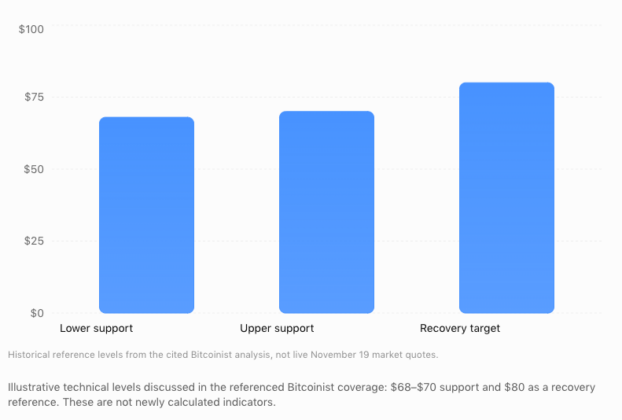
On the technical front, market participants should monitor whether SOL can carve out a higher low, recapture key moving averages, and exhibit strengthening momentum.
A sustained break above the 50-day moving average could signal early short-term momentum building. However, a definitive trend reversal demands wider confirmation, such as heavier trading volume and an improved overall market structure.
Until those indicators materialize, corporate announcements should be treated as potential long-term catalysts rather than assurances of immediate price gains.
What Comes Next For Solana And ZelleUSD?
Zelle’s global expansion strategy could serve as a major test of Solana’s capacity to host financial services outside of crypto trading.
The corporation’s initial cross-border goals encompass remittances between the United States and India, though exact timelines and the launch date for live Solana-based settlements remain unconfirmed.
A successful rollout could inspire other financial institutions to investigate comparable infrastructure.
For Solana, the potential stretches far beyond the $1.25 million test itself.
The true significance lies in whether major financial houses routinely adopt the blockchain for transfers, clearing, and tokenized financial assets.
While the near-term trajectory of SOL will remain tied to broader market cycles, milestones like ZelleUSD signal that Solana’s long-term adoption narrative is still unfolding.
And should institutional payment flows start driving measurable network expansion, the market may soon find another catalyst to reevaluate SOL’s valuation.

Written by

 Yuki Yamamoto


 crytonewsbulls