




Key takeaways
- DOGE fell 25.3% in November through Thursday’s close, following a 20% drop in October, which erased roughly 40% of its value since late September.
- December’s average return of 29.6% across the 2017-2025 period is heavily influenced by a 331.6% surge in 2017; omitting that year drops the average to about -8.2%, with a median of -12.6%.
- DOGE closed December in positive territory in only four out of nine years.
- Out of five negative Novembers recorded since 2017, four were succeeded by continued declines in December, with 2018 acting as the sole exception (+8.4%).
- Following a 25.3% loss, DOGE requires a rally of about 34% to reclaim its November opening price, and roughly 67% to recover the combined losses from October and November.
As November draws to a close, the price of Dogecoin has dropped nearly 25% since the beginning of the month. While historical performance hints that December could bring relief, a deeper inspection of the data shows why traders should exercise caution before anticipating a year-end rebound.
Market statistics compiled by ReturnsView show that DOGE dropped 25.3% in November through the close on Thursday, coming on the heels of a 20% decline in October. Combined, the two consecutive months have wiped out about 40% of Dogecoin’s total value since the end of September.
At first glance, historical trends for December appear much brighter. However, that optimism is largely driven by a single outlier year.
Dogecoin’s Bullish December Average Hides An Uncomfortable Truth
Between 2017 and 2025, Dogecoin produced an average December return of roughly 29.6%, making the concluding month of the year seem like a lucrative time for buyers.
Yet, DOGE actually finished December in the green during only four of those nine years.
The inflated average is heavily skewed by December 2017, when Dogecoin skyrocketed 331.6% amid a wildly speculative phase in the early crypto market.
Excluding that single month pushes Dogecoin’s average December return down to -8.2%.
Meanwhile, the median return across the entire nine-year dataset—which is less vulnerable to extreme spikes—sits at -12.6%.
Dropping 2017 from the figures does not mean another massive surge is out of the question. It simply demonstrates how misleading the headline average can be regarding typical December price action.
What Happens To Dogecoin After A Losing November?
Another historical trend deserves attention, particularly in light of DOGE’s sharp losses this month.
A December 2025 review of Dogecoin’s seasonal cycles by Bitcoinist highlighted a tendency for November downturns to bleed into December, and the outcomes from last year add further weight to that pattern.
Ever since 2017, Dogecoin has posted five negative Novembers, four of which experienced additional drops throughout December.
In 2021, DOGE slid 23.3% in November and dropped another 20.7% in December. The following year proved even worse, as December losses escalated to 34.3% on the heels of a down November.
The trend repeated last year, when Dogecoin fell 21.7% in November 2025 before shedding an additional 19.6% in December.
The lone exception occurred in 2018, when DOGE bounced back with an 8.4% gain in December despite suffering a 42.5% drop the month prior.
With only five data points, there is not enough evidence to form a reliable trading rule. Even so, the historical data offers little indication that a severe November slump guarantees a December turnaround.
What Would A December Recovery Actually Look Like?
The magnitude of Dogecoin’s recent drop presents a mathematical obstacle for market participants aiming to recoup their losses before year-end.
A 25.3% downturn demands a subsequent increase of nearly 34% just to break even with the starting price.
Wiping out the combined losses from both October and November calls for an even larger advance of roughly 67%, assuming November closes near Thursday’s levels.
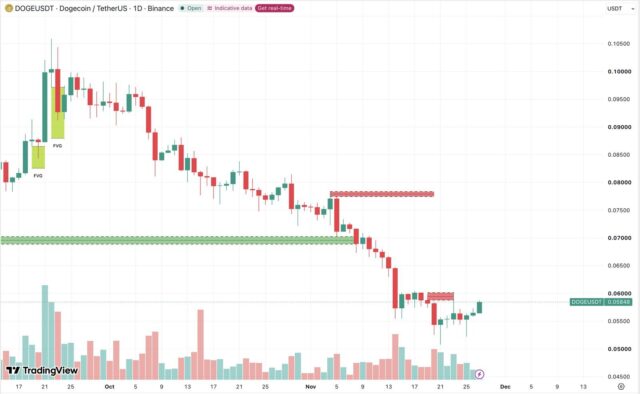
Investors monitoring Dogecoin’s valuation and market trends should focus on whether a December rebound is supported by consistent spot demand and increased volume, rather than depending solely on past seasonal patterns.
Dogecoin has pulled off massive rallies in the past, and its inherent volatility leaves room for a sudden rebound. However, December’s reputation as a profitable month relies heavily on market dynamics from nearly a decade ago.
The calendar page is about to turn. Whether market demand for DOGE follows suit remains to be seen.

Written by

 Yuki Yamamoto