




- Galaxy Digital’s Alex Thorn reportedly questioned why Crypto.com still directs users to a proof-of-reserves assessment dating back to December 2022.
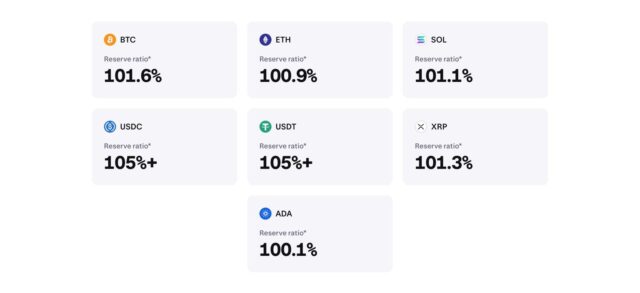
- Conducted by Mazars as of December 7, 2022, the report evaluated nine assets and found reserve ratios of 102% for BTC, 101% for ETH, and 106% for USDT.
- The document represents an agreed-upon procedures engagement rather than a complete audit and provides no information on balances following that specific date.
- Although Crypto.com shares select wallet addresses and a CDCBTC reserve dashboard, neither source reconciles the full extent of the platform’s customer liabilities.
- While the age of the report does not imply a financial deficit, it leaves the timeline for any upcoming independent evaluation unclear.
Fresh questions are being directed at Crypto.com concerning its reserve disclosures after Alex Thorn, head of research at Galaxy Digital, reportedly raised concerns over the exchange’s continued reliance on a verification from December 2022.
Thorn brought up the matter on Sunday, highlighting the vintage of the exchange’s publicly accessible proof-of-reserves documentation. Industry-wide discussions on reserve transparency have persisted since the collapse of FTX, prompting platforms like Binance to roll out frequent proof-of-reserves reports to ease user concerns.
An examination of Crypto.com’s reserve verification shows that the platform continues pointing back to that same historical evaluation. At the same time, the company makes certain wallet holdings public and runs a distinct reserve dashboard for a specific product.
This setup leaves customers facing a fundamental question: how much clarity do they truly have today regarding the assets stored on their behalf?
What Crypto.com’s 2022 Reserve Report Actually Shows
Published by Mazars on December 9, 2022, the original report compared the exchange’s asset holdings against corresponding customer liabilities tallied on December 7 of that year.
The assessment encompassed nine distinct cryptocurrencies, including Bitcoin, Ethereum, XRP, Dogecoin, and stablecoins like USDT and USDC.
At the time of review, Mazars documented reserve ratios of 102% for Bitcoin, 101% for Ethereum, and 106% for USDT.
A crucial limitation accompanies the document: Mazars executed an agreed-upon procedures engagement rather than a comprehensive financial audit. Its conclusions shed no light on transactions or account balances occurring after the reporting deadline.
To verify holdings, Crypto.com utilized a cryptographic tool known as a Merkle tree, enabling qualifying users to confirm whether their balances factored into the evaluation without exposing private account data to the public.
While this method assists users in validating inclusion in a specific historical snapshot, it cannot prove that those exact reserve ratios have persisted nearly four years later.
Crypto.com Has Newer Reserve Data, But Its Scope Is Different
The exchange maintains that customer funds remain fully backed and ready for withdrawal, having shared prominent wallet addresses through its reserve transparency portal.
Additionally, Crypto.com runs a dedicated proof-of-reserves dashboard for CDCBTC, its proprietary wrapped Bitcoin asset.
This dashboard juxtaposes the amount of CDCBTC currently in circulation against the Bitcoin reserves supporting it. Unlike the older Mazars review, it provides updated reserve metrics.
Nevertheless, confirming the collateralization of a single wrapped token is entirely distinct from reconciling the total customer obligations of an entire cryptocurrency exchange.
Publicly viewable wallet balances highlight funds sitting in designated addresses, but without an accompanying breakdown of what the platform owes users, these figures alone fail to demonstrate the adequacy of overall reserves.
Other trading platforms have adopted an ongoing schedule for reserve checks. Kraken, for instance, lists a recent proof-of-reserves reporting date of September 30, 2026.
| Disclosure | What it covers |
|---|---|
| Mazars reportAs of Dec 7, 2022 | Holdings of nine assets against customer liabilities; agreed-upon procedures, not an audit |
| CDCBTC dashboardAs of recent snapshot | CDCBTC in circulation against the Bitcoin backing it; not exchange-wide liabilities |
| Kraken proof of reservesAs of Sep 30, 2026 | Recurring reserve assessment at a rival exchange, shown for comparison |
Reserve disclosures referenced in this article and what each one can show. Source: Crypto.com, Mazars, Kraken; Bitcoinist analysis.
This comparison does not prove that one platform is financially sounder than another; rather, it highlights differences in how often users can review updated reserve evaluations.
Why The Reporting Date Matters
Back in 2023, the Public Company Accounting Oversight Board cautioned investors against viewing proof-of-reserves reports as direct replacements for standard financial audits.
Even freshly published evaluations carry inherent limitations. Their utility hinges on the specific assets and liabilities checked, the methodology used, and the verification date.
Although Thorn’s remarks do not indicate that Crypto.com is experiencing a reserve shortfall, the advanced age of the Mazars evaluation linked on its site brings up valid questions surrounding transparency.
The unresolved question is whether Crypto.com plans to release a fresh independent assessment covering its wider customer liabilities and matching reserves, and when users might see it.

Written by

 Yuki Yamamoto